


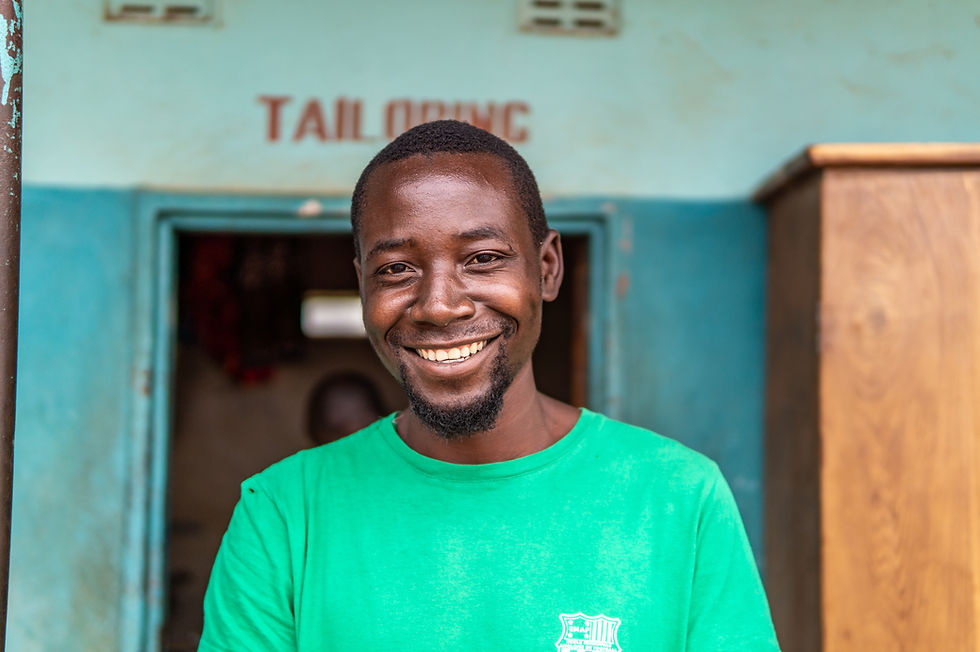
During a recent visit to Zambia, we saw tools in action through the work of the Samfya District Development Team; there, we met people such as Richard, whose lives and businesses have benefited from the tools they have received.
In Luapula Province, Zambia, learning a skilled trade can open the door to a better future. For people living in rural communities, however, having the skills is only part of the challenge.
Good-quality tools are also needed to turn those skills into a job, a business and a reliable income.
This is where TWAM tools can make a real difference.
One of our many teams in Zambia, the Samfya District Development Team (DDT) supports a network of skills groups and trainers across Luapula Province. The team there, all TWAM volunteers, work closely with local communities to understand what tools are needed, to distribute the refurbished tools we send, and to help skilled people connect with customers and markets.
This means that tools can reach people in communities that might otherwise struggle to access them.

One of the places we visited showed just how much can be achieved when communities work together.
The local village head woman has donated three hectares of land to the DDT. The land will eventually become home to a training centre, where people can learn practical skills and prepare for work.
We walked around the boundaries of the land, marked by corner blocks, and saw the first work taking place to clear the site.
Nearby, local brickmakers were already busy digging clay. Much of the clay is taken from anthills and termite mounds, which provide particularly sturdy - and sustainable - material for making bricks. These bricks will be used to build the new training centre.
It is still early days, but the beginnings of the project are already visible.

Richard first learned carpentry from his father. Like many skilled tradespeople, he began with practical experience, learning how to make and repair things with his own hands.
Over time, Richard built on those skills and opened his own carpentry workshop. He later added a welding workshop, giving him the ability to take on a wider range of work. Today, Richard's businesses provide employment and training for other people in his community.
The carpentry workshop employs seven people, including four trainees. One of those people is Evans.
Evans is a member of Richard's team and is gaining practical experience in both carpentry and welding. By learning two different trades, he is developing a wider range of skills that can help him find work and support himself in the future. The team makes a wide range of products and structures, including beds, doors and tables. They also make roofing and structural frames for houses.
But having the skills and having the work are not enough on their own. To produce these items, Richard and his team need reliable tools.
And TWAM was there.
Richard received tools via the DDT in 2025, including power tools, planes, and electrical equipment. Now. seeing Richard's workshops in action is a powerful reminder of why refurbishing tools matters.
A tool that is no longer needed in the UK does not have to become waste. With care and skilled refurbishment, it can be given a second life and put back to work!


Comments