


Updated: Sep 4
Last year, TWAM sent 2,232 electric sewing machines to Africa, providing much-needed equipment for trainee tailors and those seeking to learn a new skill. Today, we introduce you to one of them!
When Jeff Musonko looks towards the future today, he sees something he once thought impossible: a tailoring shop of his own.
It is a simple ambition. A small workshop. A rented space. A sewing machine. Customers coming through the door. A way to provide for his family through his own hard work.
For many of us, such a dream might seem within reach. But for Jeff, it represents a remarkable journey from uncertainty to independence - a journey made possible through the Disabled Care Organisation in Solwezi, Zambia.
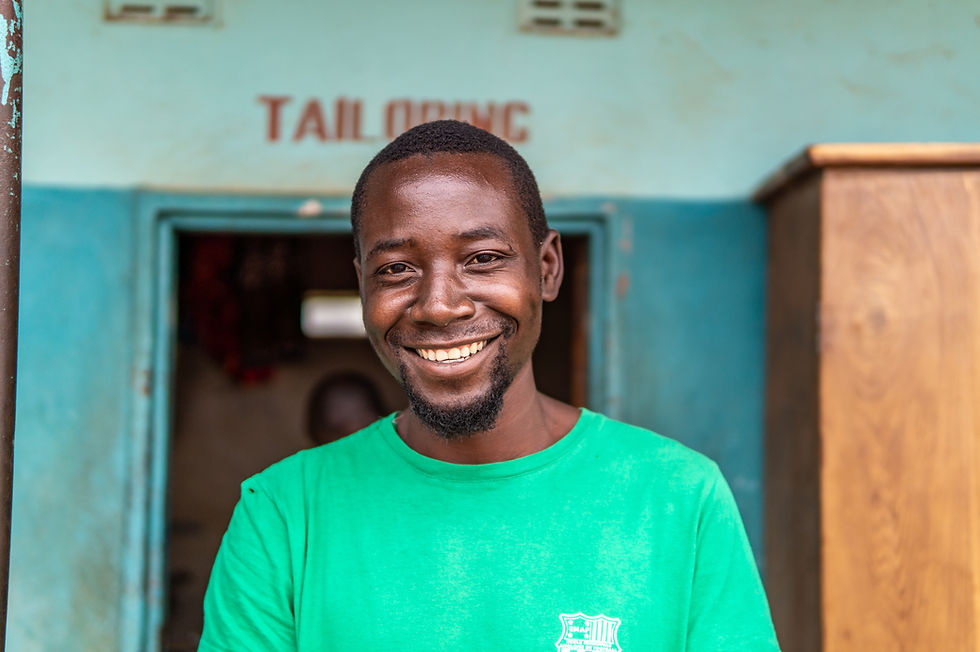
Like many young men, Jeff had hopes for his future. He wanted to become a nurse. Having a disabled person in his family meant that caring for others always appealed to him, and he longed for a career where he could make a difference.
But dreams alone cannot pay college fees.
"I completed school a long time ago," Jeff recalls. "But I had nothing to do. There was no money for me to go to college. This plan had failed for now, and I had nothing else.""
Without the money to continue his education, those ambitions slipped away. Suddenly, there was no clear path ahead. For many people, that might have been where the story ended. But for Jeff, it was only the beginning.

Since opening its doors in 2005, the Disabled Care Organisation has been transforming lives in and around Solwezi.
The organisation exists to empower people with disabilities, while also recognising that lasting change often begins with families. Parents and relatives of disabled children are invited to come and learn practical skills alongside the students, enabling a wide reach of essential skills. This also provides additional income for poor families, ensuring they can afford to educate their disabled children and pay for the care they need.
For many disabled people in rural Zambia, daily life presents challenges that many of us rarely consider. Limited mobility, inaccessible transport, and a shortage of suitable wheelchairs can make finding employment exceptionally difficult.
Disabled Care seeks to meet those challenges. Every day, morning and afternoon training sessions welcome around twenty students at a time. Over six months, they learn practical, marketable skills in tailoring, carpentry, knitting, metal fabrication, computing, and electrical work. At the end of their course, students sit an examination through a local college, receiving a recognised certificate that opens doors to employment.
Graduates are also given the tools they need to begin earning immediately, many of which are supplied through the generosity of TWAM supporters. Rather than leaving with only knowledge, students leave equipped to put their new skills into practice.

Jeff had seen tailoring before. Growing up at the Catholic mission at Disabled Care, where he still lives today with his wife, two children and parents, he had watched others sewing and making clothes for years.
"I saw people there who were tailoring, and they started teaching me when I was 15," he says.
When the opportunity came to remain at Disabled Care and enrol, rather than leave and try his luck on an unforgiving job market, Jeff embraced it wholeheartedly. Since we first met him two years, he has completed his tailoring course and took advantage of another rare opportunity - to remain at Disabled Care as a trainer.
The work is demanding but rewarding. Disabled Care has secured a contract with a nearby mining company to manufacture 10,000 heavy-duty sandbags every month. Working together, the tailoring team - trainers and students alike - cuts, stitches and finishes each bag with astonishing speed - often completing one in just a few seconds.
The contract provides much-needed income for the organisation, helping to sustain its work while also providing wages for the people producing the bags. It is a model that combines training with real employment, allowing skills to become sustainable livelihoods.
"I get paid by this organisation and that money sustains me and my family," Jeff says simply.

The team at Disabled Care hopes to secure a second manufacturing contract in the future, creating even more opportunities for disabled trainees to earn an income through their work.
For Jeff, however, there is another dream quietly taking shape.
"I want to open my own tailoring shop one day. I need to save money first to pay for rent." It is a modest goal, but one built on confidence, experience and determination - all qualities that were nurtured through the support he received. Jeff hopes to use a TWAM treadle - one he learnt on, and which he has learnt how to maintain and upkeep. "And with God's help," he concludes, "I will then be earning enough to pay for an initial course in nursing."
Jeff's story reminds us that poverty is not a lack of ability. Often, it is simply a lack of opportunity. And when people are given training, practical tools, and the chance to earn a living, extraordinary transformations can happen.
A young man who once believed his future had ended now has a profession.
A father who once had no work now provides for his family.
And a dream is no longer impossible.
This is the impact of the Disabled Care Organisation. It is also the impact made possible through the refurbished tools provided by TWAM, and the generosity of supporters who believe that everyone deserves the opportunity to build a better future.


Comments